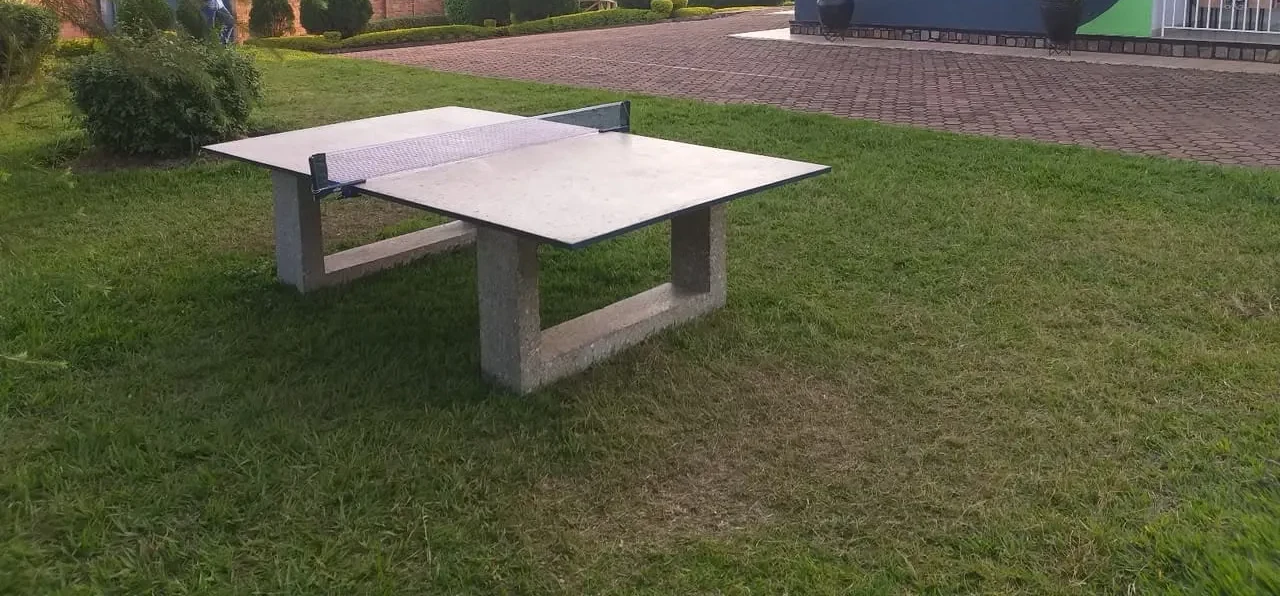
A ping-pong table in Africa that stays outdoors all year needs to be built for the job. Portable folding tables are convenient, but they are not designed to be left in sun and rain, and they are easily moved or damaged. A permanent concrete table gives schools, hotels, compounds and parks a fixed place to play. This guide explains how to choose one and how to prepare for it.
Why choose a concrete ping-pong table in Africa?
A concrete table-tennis table in Africa is a long-term fixture. It is heavy and stable, so it does not wobble when players lean on it, and it is intended for outdoor use rather than for storage in a hall. Because it is permanent, it also becomes a natural meeting point in a courtyard or garden. RCGF manufactures ping-pong tables in precast concrete, alongside the rest of our outdoor concrete furniture.
Where a concrete ping-pong table for schools and hotels fits
- Schools: a courtyard or playground table gives students an active break-time option. Place it where staff can see it easily.
- Hotels and resorts: a table in a garden or recreation area gives guests a simple activity that suits all ages.
- Residential compounds: a shared table encourages neighbours to meet and is useful for children and adults.
- Parks and community spaces: a permanent table can serve a wide group of users with no booking system.
In each case, look for a spot with enough free space on every side for players to move, and avoid placing the table beside a road, a pond or a fragile window. Hotels may also like to read our guide on outdoor furniture for hotels and restaurants.
Think also about supervision and opening hours. A school may want the table available only at break times, while a hotel may leave it open during the day. Because the table is permanent, it is worth agreeing in advance who is responsible for the bats, the net and the daily check of the surface. A clear routine keeps the table in good condition and avoids disputes between users.
Prepare level ground before installation
Level ground is the most important preparation step. A concrete table cannot be adjusted easily once it is in place, so the surface under it should be firm and flat. Paving, a concrete slab or a well compacted base is usually more reliable than bare soil, which can settle after rain. Check the route to the site as well: because concrete is heavy, the access path must allow the table to reach its final position. Delivery and installation terms are confirmed per project, so tell us about your site early.
What to bring: net, bats and balls
Make sure you understand what comes with the table and what you need to arrange separately. Bats and balls are normally separate purchases, and the net should be discussed with us during the quotation so that you know exactly what is included for your project. Many venues keep bats and balls in a reception, a sports room or a classroom cupboard so that they are not left outside.
Looking after an outdoor concrete table
Concrete is a durable material, but simple habits keep the playing surface pleasant. Sweep away leaves and grit before play, wipe off dirt and spills, and avoid leaving heavy objects on the surface. Wind can affect outdoor play, so a sheltered corner or a hedge on the windward side is a sensible choice. For general care routines, read how to maintain concrete outdoor furniture.
Finally, consider the space around the table. Players need room to step back and move sideways, so a table pushed against a wall or hedge will feel cramped. A shaded edge is welcome for spectators and for players waiting their turn. A bench or two nearby, such as the concrete benches we make, turns the table into a small recreation corner.
Request a quote for your table
Send us the venue type, your location, the number of tables, photographs of the planned spot and any dates you have in mind. If you are equipping a larger area, we can quote benches, tables and planters together so that the whole space is planned at once. Contact us by form, phone or WhatsApp and we will reply with a quotation.